|
St. Gregory VII, Pope (c. 1013-1085) |
|
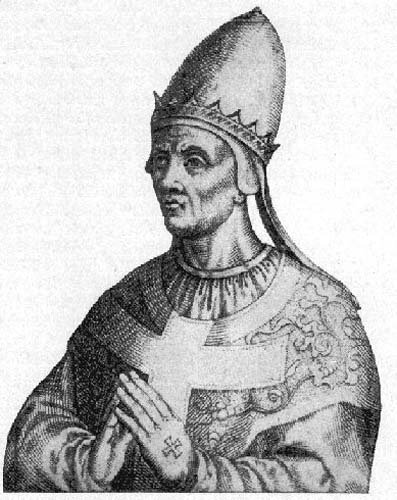
SAINT GREGORY VII Pope Gregory VII, born Hildebrand, was from southern Tuscany. He was educated at a monastery and was appointed deacon and legate by four successive popes. As the legate of Victor II, he condemned simony at a council in Lyons. He also successfully opposed the Roman aristocracy's appointment of an antipope, Benedict X. He was elected pope in 1073 by popular support. He then codified priestly celibacy and banned simony. Pope Gregory's reforms were unpopular among churchmen associated with Emperor Henry IV of Germany. The Emperor was at war with Catholic princes; and the pope's denunciation of certain clergymen provoked his anger. The first threat against Pope Gregory's life came from Cencio Frangipane. The latter, who practiced investiture and attempted to influence papal elections, wounded Pope Gregory during the Christmas midnight Mass of 1075 and imprisoned him. Pope Gregory was rescued the next day by the populace. Pope Gregory's conflict with Emperor Henry escalated when the latter convened a council to depose the elected pope. The populace and the majority of German princes opposed Henry's move; and the latter was forced to reconcile. However, further military victories against Catholic princes emboldened Henry, who captured Rome in 1084. Henry then instated an antipope and besieged Pope Gregory at the castle of St. Angelo. Pope Gregory set into canon law that only the College of Cardinals could elect a pope. In addition, only the pope could invest bishops with authority. The reforms were deeply unpopular overseas, including France and England. His reforms were the first to secure the independence of the Church and integrity of the priesthood. On May 25, 1085, at the age of 72, during the twelfth year of his pontificate, he went to his eternal reward. He was canonized in 1748. ©Evangelizo.org |